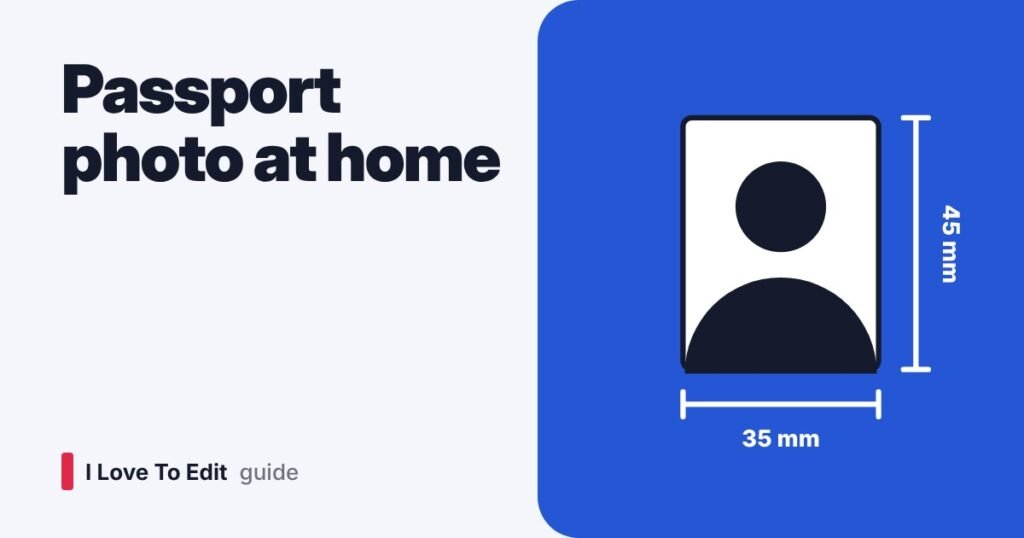
A photo booth charges for four prints, half of them with your eyes shut. A phone, a window and a plain wall do the same job, as long as you follow the rules of the country you’re applying to. Those rules are stricter than most people expect.
The sizes that cover most applications
- United States: 2 × 2 inches (51 × 51 mm). Head from chin to top of hair between 1 and 1⅜ inches. White or off-white background.
- United Kingdom: 35 × 45 mm for prints, with a plain cream or light grey background. Digital photos for online renewal have their own pixel rules.
- Schengen visa and most of Europe: 35 × 45 mm, with the face taking up 70 to 80% of the height.
Other countries differ, and rules change. Read the official page for your application before you print anything.
Taking the picture
Stand about half a metre in front of a plain light wall, facing a window. Daylight from the front gives even skin and no shadow behind your head. Avoid ceiling lights alone: they put dark hollows under the eyes.
Ask someone to hold the phone at your eye level, around 1.5 metres away, using the back camera. Selfies fail for two reasons: the front lens is wide and stretches the nose, and your arm tilts the shot. Leave space all around your head. It’s cropped later.
Neutral face, mouth closed, eyes open and on the lens. Take ten shots. Hair off the eyes. The US has banned glasses in passport photos since 2016, and many other countries discourage them because of glare.
Cropping and laying out the sheet
Open the best shot in Passport Photo Maker, choose the country size, and move the crop until your head sits inside the guides. Then let it place several copies on one sheet. A 4 × 6 inch print at a pharmacy or photo shop costs very little and holds six 35 × 45 mm photos.
Printing at home on A4? Print Photos on A4 sets out the copies with cutting gaps. Use glossy or satin photo paper and print at 100% scale, never “fit to page”, or the photos come out the wrong size.
If the wall wasn’t white enough
You can cut yourself out with a background remover and place the cut-out on white using Change Background. Be careful here. Check the hair edges at full zoom, and don’t retouch your face. Authorities reject photos that look edited, and some countries don’t allow digitally changed backgrounds at all. A second attempt against a better wall is the safer route.
What gets photos rejected
Shadows on the background, a head that’s too large or too small in the frame, a tilted head, and prints on plain office paper. Measure the printed photo with a ruler before you post it.
Common questions
Can I smile in a passport photo?
The US allows a natural smile. The UK and Schengen rules ask for a neutral expression with the mouth closed.
How recent must the photo be?
The US asks for one taken in the last six months. The UK asks for the last month. Check your own country.
What resolution do I need?
For a sharp print, 600 dots per inch is the usual target: about 827 × 1063 pixels for a 35 × 45 mm photo.